Reading time: 14 minutes
- 3
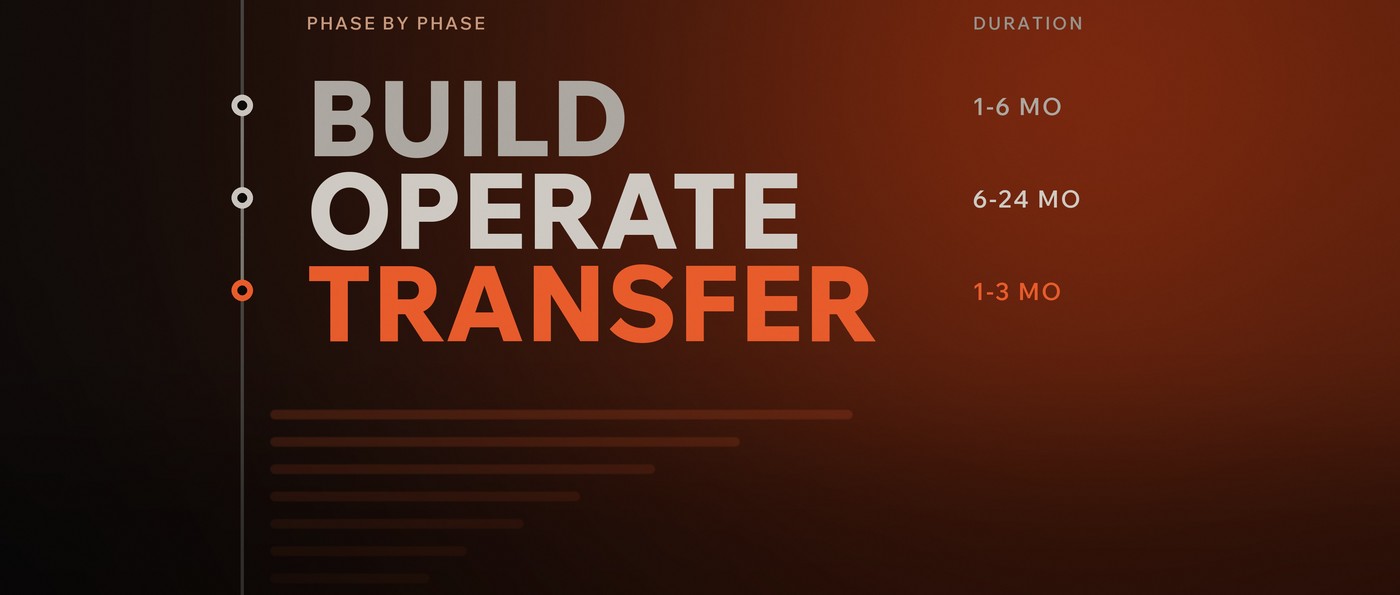
- Phases: build, operate, transfer
- 18-36 mo
- Typical full engagement, kickoff to ownership
- $4-8K
- Monthly per developer, fully loaded
- 40-60%
- Commonly cited cost gap vs US hiring
There are two ways companies usually get offshore engineering capacity wrong. One is renting it indefinitely through traditional outsourcing, which never builds you an internal asset. The other is trying to stand up your own captive development center and getting buried in local employment law, payroll compliance and hiring logistics in a country where you have no presence. The build-operate-transfer IT model exists for the space in between.
You get the cost advantage of nearshore outsourcing and the long-term control of a captive center. You do not carry all the upfront risk. At ITDS Nearshore we run this full lifecycle from Poland and Portugal, from initial sourcing through the final legal transfer. Below: how each phase works, what it costs, what belongs in the contract, and when the model is the wrong choice.
What the build-operate-transfer IT model actually is
A vendor builds a dedicated IT operation on your behalf, typically an offshore development team or a full development center. They operate that team for a defined period, then transfer complete ownership to you: the people, the processes, the infrastructure, the intellectual property. At that point you have your own captive center staffed by a team that already knows your product.
What makes it BOT rather than something else is that the intent to transfer ownership is written into the contract from day one. Build-own-operate-transfer variants work differently: there the vendor holds legal title all the way through the operate phase, until handover.
BOT compared with the alternatives
| BOT | Traditional outsourcing | Own captive center | |
|---|---|---|---|
| What you get | A capability you will own | A service you rent | Full ownership from day one |
| Transfer mechanism | Contractual, from day one | None | Not applicable |
| Who carries setup risk | Mostly the vendor | The vendor | You, entirely |
| Time to a working team | 1 to 6 months | Weeks | A year or more |
| Ongoing cost | Per-developer plus management fee | Per-developer or per-project | Direct payroll and overhead |
| Best when | Long-term ownership plan, no local presence | No ownership ambition | You already know the market |
Swipe the table sideways to see all columns.
A captive center gives you full ownership immediately, which sounds ideal right up until you are navigating local employment law, setting up payroll and hiring senior engineers in a market you do not yet understand. BOT takes most of that off your plate. The vendor acts as employer of record, absorbs the compliance and hiring complexity, and hands over a functioning operation once it is mature. If you are setting up in Poland, the government's Invest in Poland resources spell out what entity formation actually involves.
What you pay for that is the management fee during Operate, plus the months it takes to reach transfer readiness. For US companies moving into a market with no local infrastructure, that is usually a fair trade. Weigh it against your own timeline and risk tolerance.
How the three phases run in practice
Most BOT engagements go wrong because nobody was clear on what each phase was supposed to produce. Here is what actually happens in each one.
- Build · 1 to 6 months
Assembling the team and infrastructure
The heavy lifting: legal entity setup or employer-of-record arrangements, office or remote infrastructure, technology stack preparation, and the bulk of initial hiring. A provider with an existing pre-vetted talent pool can compress this phase meaningfully. For standard team profiles, a couple of months is reasonable. For specialised roles like senior security architects or AI engineers, plan closer to six months. The goal here is a functioning team that can begin delivery, not a perfect team. Refinement is what Operate is for. - Operate · 6 to 24 months
Running the centre and hitting KPIs
The longest phase. The vendor handles day-to-day operations: HR, payroll, performance management, team scaling, governance reporting. You handle technical direction, product priorities and steering committee participation. You should not be in the administrative weeds. This is where KPIs get established and tracked, team culture is shaped around your engineering standards, and processes are documented for handover. It is also when you decide whether to accelerate toward transfer or extend. Let transfer readiness metrics drive that call, not vendor pressure in either direction. - Transfer · 1 to 3 months
Handing ownership to you
Legal entity transfer or share capital purchase, employment contract migration for the team, knowledge transfer audits, and post-transfer vendor support. When it goes well, you inherit a centre staffed by engineers who already know the codebase, the roadmap and the team norms. When it goes badly, usually because the contract clauses were not there, it turns into a scramble over incomplete documentation and unclear ownership.
Timelines and where your budget actually goes
Build duration varies. Standard team profiles in Poland or Portugal often take a couple of months with a provider that already has a talent pipeline, while larger or more specialised teams push closer to six. Confirm current figures with a provider before building a specific budget.
| Phase | Cost range | What it covers |
|---|---|---|
| Setup and transition | $10,000 to $50,000 | Entity formation, initial hiring, infrastructure |
| Operate, monthly per developer | $4,000 to $8,000 | Management overhead, HR, payroll compliance, office infrastructure |
| Transfer, legal | $5,000 to $20,000 | Entity handover, plus contract migrations and knowledge transfer support |
Swipe the table sideways to see all columns.
The cost profile sits mostly in monthly operating expense during Operate, not in a big upfront capital hit. Against domestic hiring the comparison is stark. A senior software engineer in the US can cost well into six figures in total annual compensation. The same seniority in Poland or Portugal, fully loaded through BOT, is often cited at 40 to 60 percent below that, with timezone overlap and English good enough that collaboration with a US team actually functions. Over three years that gap compounds. For the underlying salary data, see our Poland versus US developer salary benchmarks.
No governance structure can fully compensate for a team that has not had enough time in Operate to internalise your engineering standards.
What your BOT contract must cover
This is where these engagements succeed or fail. Most of the risk sits in clauses clients either skip past or accept without negotiating.
- Present-tense IP assignment. Ownership should transfer to you the moment any work is created, not through language that only promises to assign it later. That distinction determines whether you own the code being written today or only gain rights at transfer.
- Explicit phase definitions. Who has hiring authority during Build, who controls technical direction during Operate, and what documentation standards govern the Transfer handover.
- Step-in rights. Authority to intervene without breaching the contract if the vendor hits operational failure mid-engagement.
- Transfer fee caps and rate transparency. These prevent cost inflation at the exact moment you are most financially exposed.
- Exit provisions. What happens if the vendor misses performance targets, or if your business strategy shifts before transfer.
Have all of these reviewed by legal counsel familiar with the relevant jurisdictions before signing.
Transfer readiness is measurable, so track it from Operate onward. In practice that means monthly steering committee reviews on burn rate against forecast and overall team performance, plus tighter operational reviews on delivery throughput and quality. By the Transfer phase, your incoming client-side leadership should run some form of technical capability review.
SLAs on uptime and incident recovery belong in Operate, not bolted on after transfer. Throughput and defect-removal benchmarks vary too much between engagements to borrow from anyone else, so set your own targets in the contract.
Who the BOT model is actually right for
You are committed to building internal IT capacity long-term, but you do not have the local hiring infrastructure, the compliance knowledge, or the time. The common profile: a growth-stage US company, or an enterprise scaling a new product line, that needs a real number of engineers in Europe over several years. Regulated industries fit this well, fintech, healthcare and pharma especially, because they need a provider who understands the domain constraints and EU data compliance rather than one supplying generic technical resource.
You need a small number of engineers quickly and have no captive centre ambition. Pre-vetted engineers from Poland and Portugal can often be onboarded in a few weeks with no setup costs and no multi-year commitment. Our guide to augmentation versus full outsourcing covers that decision in detail.
You need a defined project delivered end to end with no intent to own the team afterward. BOT is a strategic multi-year investment. It rewards companies that enter with a clear ownership plan and works poorly for those treating it as flexible capacity they can walk away from mid-engagement.
Frequently Asked Questions
How long does a full BOT engagement take?
How is BOT different from regular outsourcing?
Is BOT cheaper than setting up my own captive center?
What should I look for in a BOT contract?
When does staff augmentation make more sense than BOT?
Start with the right partner
BOT gives you offshore economics with the control of a captive centre, but only if the partner running the lifecycle has the hiring depth, the local presence and the process maturity to execute it cleanly. That is a real filter, and it rules out a lot of vendors.
Each phase demands something different. Sourcing in Poland and Portugal needs a deep talent network and local market knowledge. Governance during Operate needs structured reporting and domain experience. The Transfer needs someone who has moved entities across jurisdictions before and knows where it gets stuck. You do not want a partner learning any of that at your expense. Learn more about our turn-key BOT solution, or see our guidance on how to successfully outsource IT engineers.
Is BOT the right model for your situation?
Book a call and we'll compare it against staff augmentation based on your team size and timeline, and map the right model to your engineering goals.
Book a consultation